

Keywords
CRISPR/Cas9
Genome-edited animals
Genome editing via oviductal nucleic acid delivery (GONAD)
Improved GONAD (i-GONAD)
Microinjection
Electroporation
Zygotes
Large experimental animals
Ferrets
Pigs
Marmosets
How to Cite
Abstract
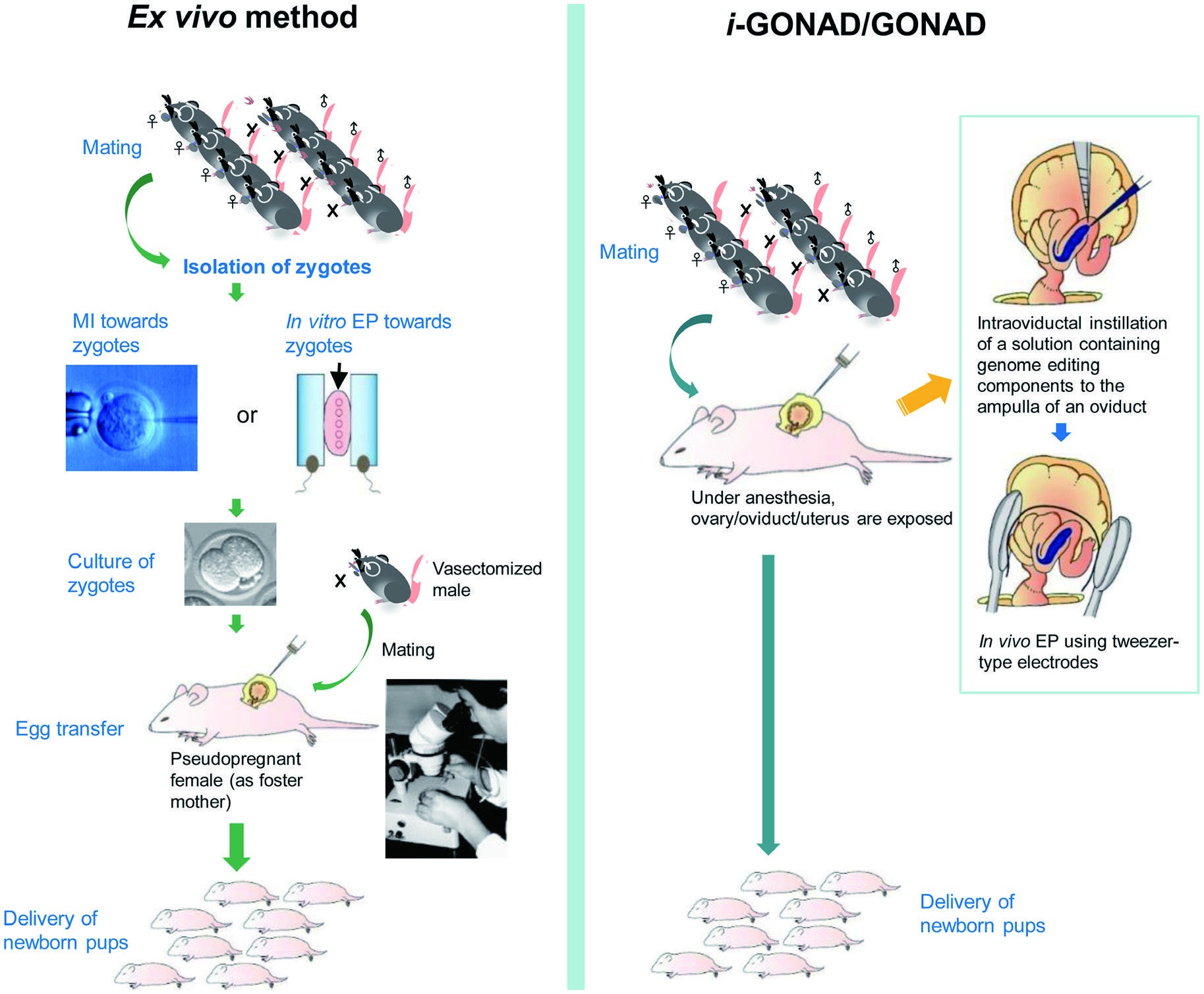
Recent advances in genome-editing technologies have enabled the efficient generation of experimental animals, such as rats and mice, with targeted mutations. Most of these experiments involve the ex vivo manipulation of isolated zygotes, into which genome-editing reagents are introduced via microinjection or in vitro electroporation. Afterward, these genomeedited (GE) embryos must be transferred back to the reproductive tract of pseudopregnant females for further develop ment. Somatic cell nuclear transfer using GE somatic cells has also been widely used to produce large GE animals, with the somatic cell nuclear transfer-treated embryos requiring transfer to recipient females to produce viable newborns. To eliminate the need for ex vivo handling of embryos, an alternative method called “genome editing via oviductal nucleic acid delivery (GONAD) or improved GONAD (i-GONAD),” has been developed. This technique enables in vivo manipulation of zygotes within the oviduct. The in situ method involves two main steps: intratubal injection of genome-editing reagents and subsequent in vivo electroporation targeting the entire oviduct. More recently, the intratubal injection of adeno-associated viral vectors carrying the necessary components for gene editing has been sufficient to introduce a desired fragment into the genome. These methods do not require the ex vivo handling of zygotes, preparation of pseudopregnant females, or egg transfer. If GONAD/i-GONAD can be successfully applied to produce large GE animals, the genetic manipulation of these animals would be greatly simplified. This review focuses on the possibilities and limitations of GONAD/i-GONAD for generating large GE animals.

This work is licensed under a Creative Commons Attribution-NonCommercial-NoDerivatives 4.0 International License.
Copyright (c) 2024 Nature Cell and Science