

Keywords
Atropine
Orthokeratology
Combined atropine with orthokeratology
Axial length
Spherical equivalent
How to Cite
Abstract
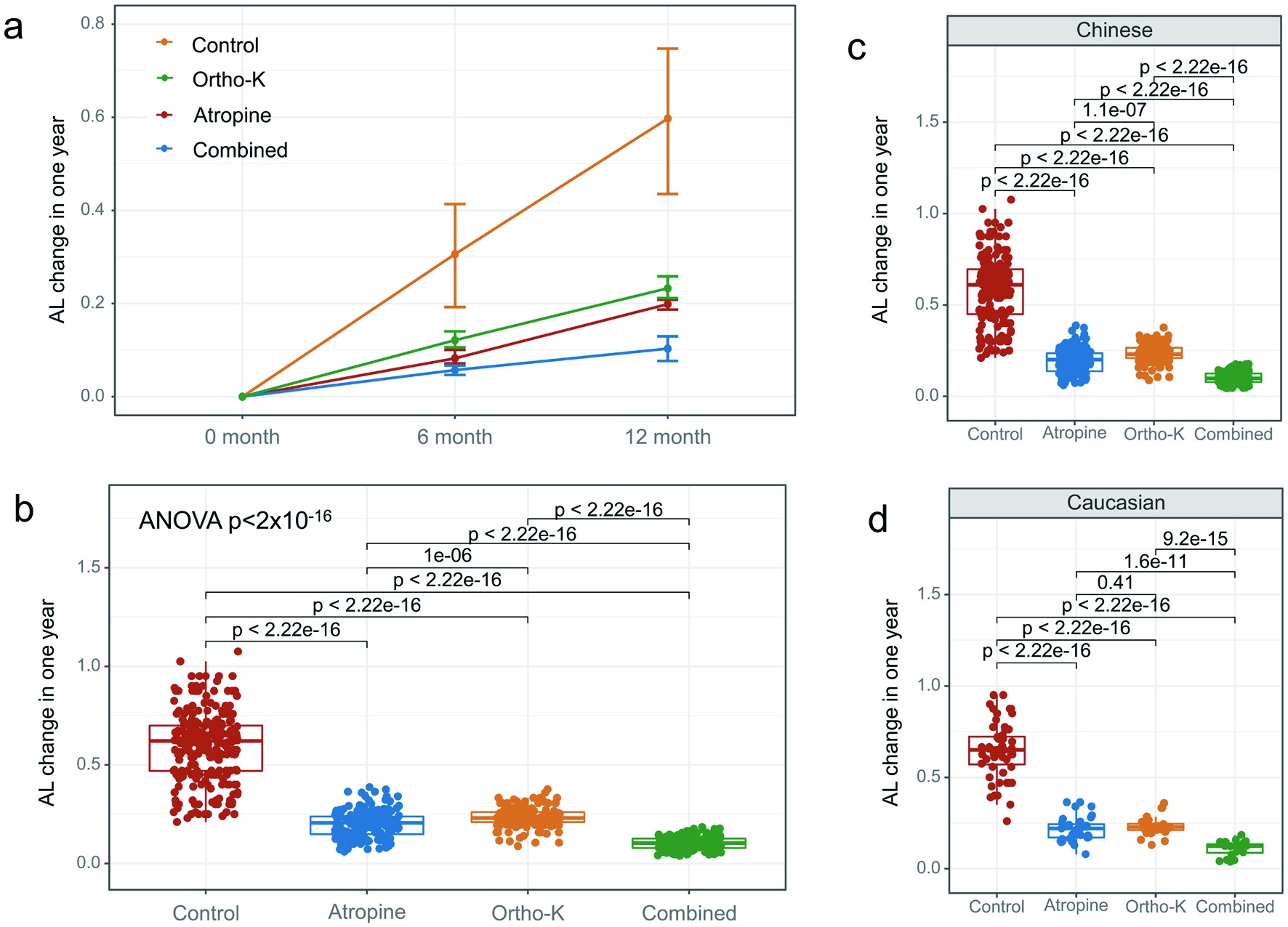
Background and objectives: Myopia affects one-third of the global population, with increasing prevalence among children and adolescents, raising concerns about long-term consequences. This study compared the effectiveness of 0.01% atropine eye drops, orthokeratology, and their combination in slowing myopia progression. Methods: Conducted across three international ophthalmic centers in China, this retrospective cohort study included Chinese and Caucasian children aged eight to 18 years with a cycloplegic spherical equivalent of −1.00 to −6.00 diopters and ≤1.50 D astigmatism in both eyes. Participants were divided into four groups: control (glasses only), orthokeratology, 0.01% atropine eye drops, and a combined orthokeratology and atropine group. Ophthalmic exams, including refractive error and axial length measurements, were conducted at baseline, six months, and twelve months. Results: The study evaluated 736 eyes from 736 myopic children: 265 in the control group, 155 in the orthokeratology group, 181 in the atropine group, and 135 in the combined treatment group. After 12 months, the combined treatment showed the greatest effect in slowing myopia progression (mean -0.25D), followed by the atropine group (mean −0.57D) and orthokeratology (mean −0.42D). All groups showed significant differences from the control group (p < 0.001). Conclusions: The findings suggest that combining orthokeratology and 0.01% atropine eye drops is more effective in controlling myopia progression than either treatment alone, offering a potential option for managing myopia in children and adolescents.

This work is licensed under a Creative Commons Attribution-NonCommercial-NoDerivatives 4.0 International License.
Copyright (c) 2025 Nature Cell and Science