

Keywords
Systems biology
Signal transduction
Biomarkers
Genome-wide genetic and epigenetic network (GWGEN)
Principal network projection
DNN-based DTI model
How to Cite
Abstract
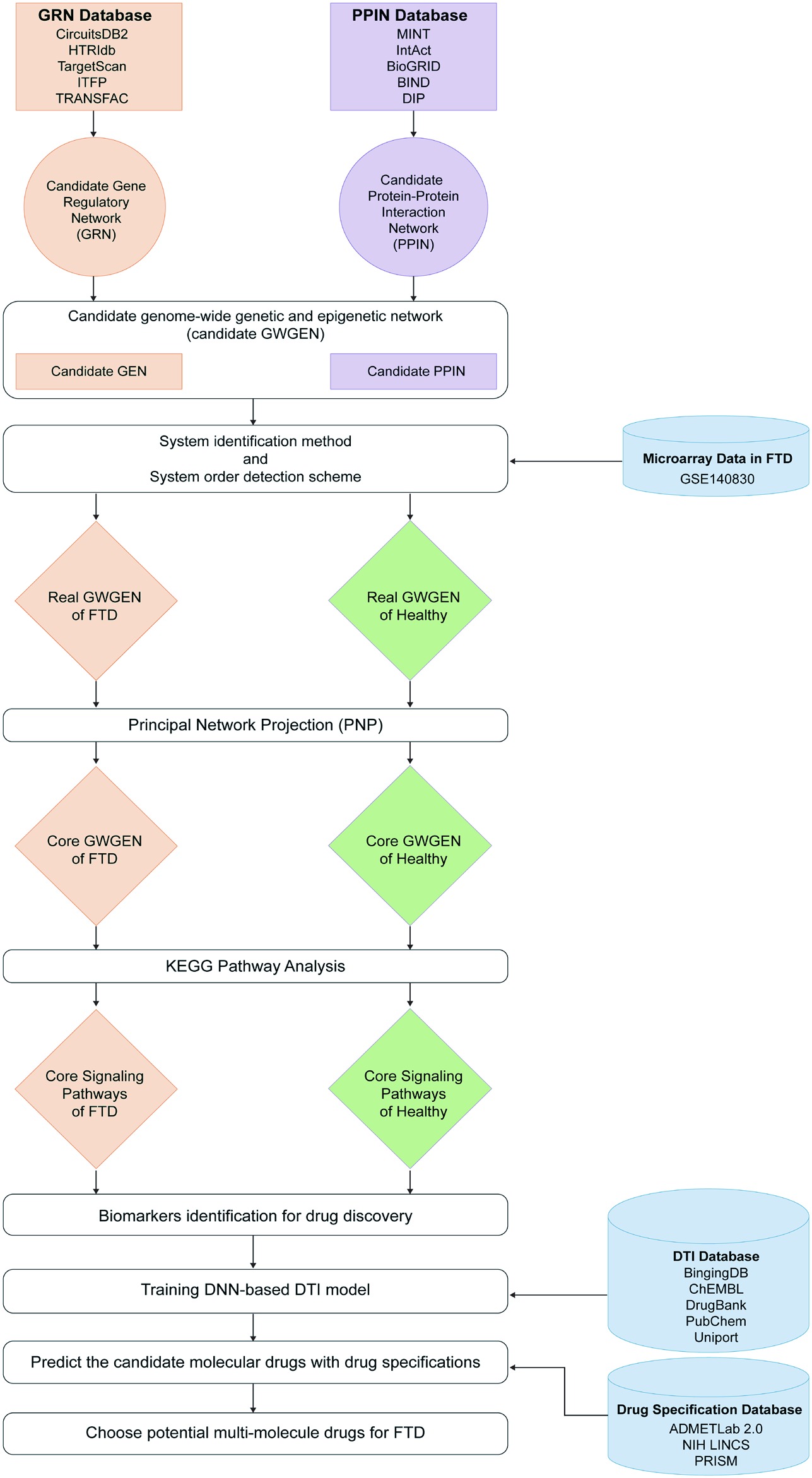
Background and objectives: Frontotemporal dementia (FTD) is a slowly progressing neurodegenerative disease. In this study, we employ systems biology methods and genome-wide microarray data to investigate the pathogenetic mechanisms underlying FTD and identify significant biomarkers as potential drug targets. We then utilize a deep neural network (DNN)-based drug-target interaction (DTI) model, along with drug design specifications, to predict and select potential molecular drugs for treating FTD. Methods: First, we constructed genome-wide genetic and epigenetic networks (GWGENs) for FTD and healthy control through large-scale database mining and system identification methods. We then extracted core GWGENs from these networks using a principal network projection method. Finally, we applied a DNN-based DTI model, trained on DTI databases, to predict potential molecular drugs. Results: We identified key biomarkers involved in the pathogenesis of FTD, including TAU, GSK-3β, STAT3, ATG5, WDR41, and RIPK1. Based on these biomarkers, we selected Iodophenpropit, Clobenpropit, TTNPB, and Probucol as candidate molecules, which were combined into a multi-molecule drug for the potential treatment of FTD. Conclusions: By combining a DNN-based DTI model with systems biology approaches, we designed a multi-molecular drug treatment for FTD. This approach enables more precise drug design and accurately predicts molecular combinations that may provide the most effective therapeutic outcomes.

This work is licensed under a Creative Commons Attribution-NonCommercial-NoDerivatives 4.0 International License.
Copyright (c) 2024 Nature Cell and Science