

Keywords
Tetrahydrocannabinol
Cannabidiol
Endocannabinoid System
Cannabis Use Disorder
Chronic Pain
Epilepsy
Multiple Sclerosis
Neuroplasticity
Adolescents
How to Cite
Abstract
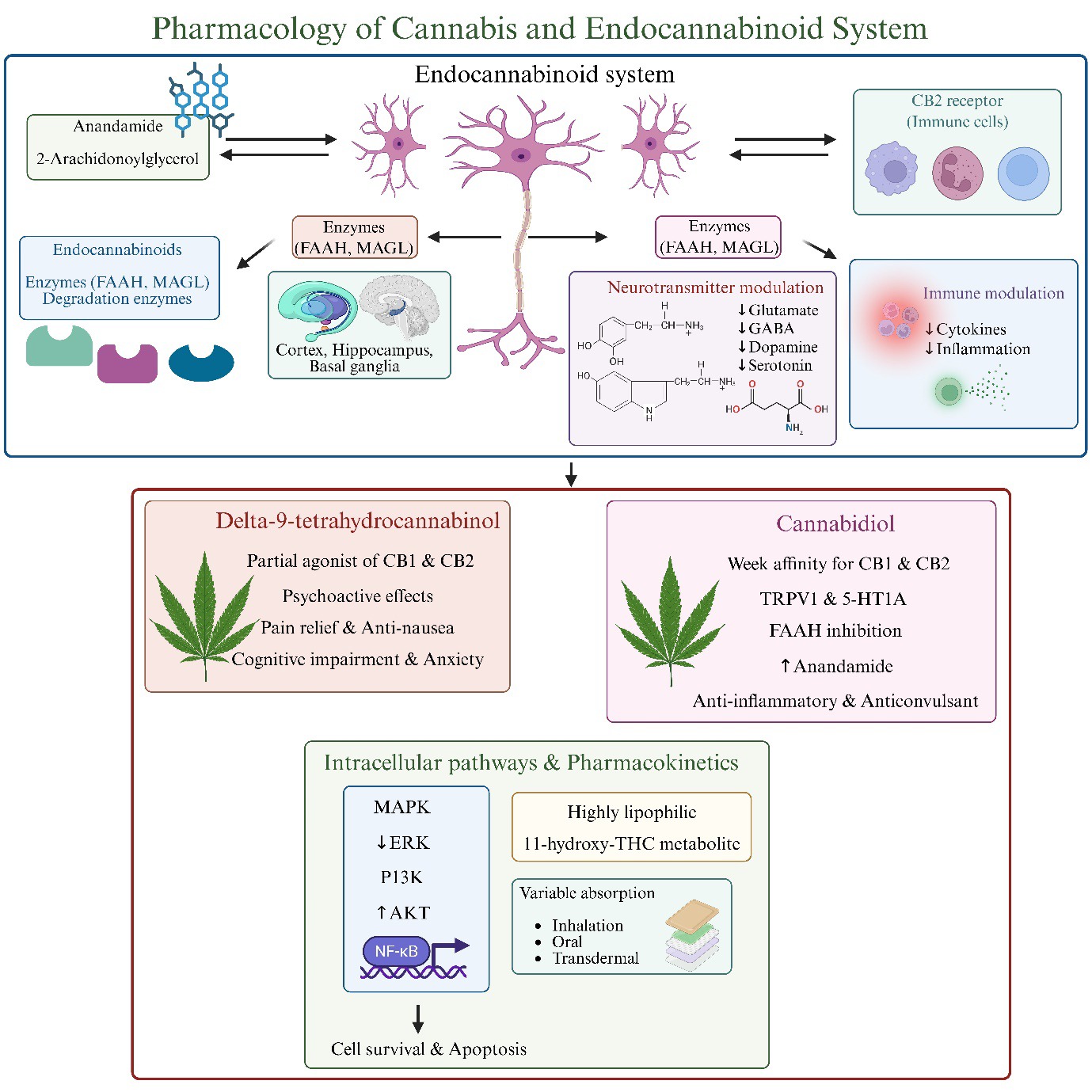
Cannabis, also called Cannabis sativa, is widely used both recreationally and medicinally for pain relief, gastrointestinal issues, mental health conditions, and seizures. However, despite its medical uses, it is often abused for its psychoactive effects. Its primary active compounds, delta-9-tetrahydrocannabinol (THC) and cannabidiol (CBD), impact the body differently by mainly interacting with the endocannabinoid system. THC acts as a partial agonist at cannabinoid receptor type 1 (CB1) and cannabinoid receptor type 2 (CB2) re ceptor, producing the psychoactive effects of cannabis and influencing dopamine-related reward pathways, and neuroplasticity. CBD, unlike THC, does not cause intoxication and offers anti inflammatory, anxiety-relieving, anticonvulsant, and neuroprotective benefits through complex mechanisms involving both receptor-dependent and independent pathways. Cannabis-based therapies and THC–CBD blends provide health benefits for conditions such as chronic pain, multiple sclerosis (MS) -related spasticity, nausea from chemotherapy, complex epilepsy, and some gastrointestinal issues by affecting inflammation and gut movement. As these treatments become more popular, concerns about misuse, tolerance, withdrawal symptoms, and cannabis use disorder (CUD) increase, especially among adolescents. Activation of CB1 receptors by THC can influence neuronal growth factors and synaptic plasticity. Adjusting dosage primarily by lowering THC and increasing CBD can reduce psychoactive and cardiovascular risks. Recent research backs new pharmacological and behavioural approaches for cannabis withdrawal and CUD, but standardized guidelines are still limited. This review highlights recent findings influence cannabis's medicinal benefits and potential risks. A thorough evaluation of these benefits and risks is essential for informed clinical decisions, responsible prescribing, and evidence-based public health policies.

This work is licensed under a Creative Commons Attribution-NonCommercial-NoDerivatives 4.0 International License.
Copyright (c) 2026 Nature Cell and Science