

Keywords
patient-derived organoids
induced pluripotent stem cells
disease modelling
precision medicine
regenerative medicine
How to Cite
Abstract
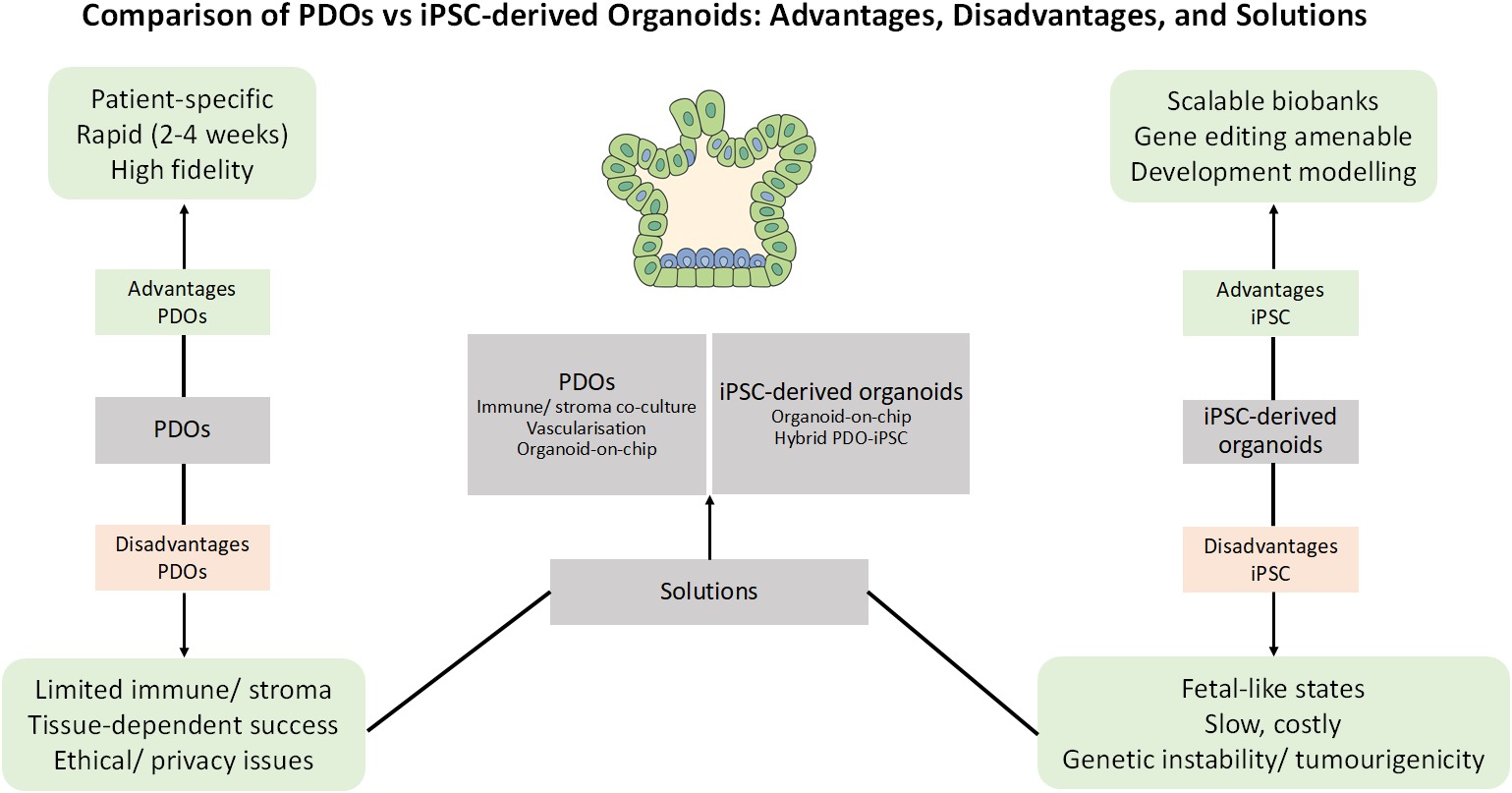
Three-dimensional (3D) organoid cultures have transformed the way researchers bridge the gap between conventional two-dimensional (2D) systems and living tissue. Here, we compare the two organoid platforms that now dominate biomedical research—patient-derived organoids (PDOs) and induced pluripotent stem cell (iPSC)-derived organoids—and consider how combining their strengths might shape the future of translational and regenerative medicine. PDOs retain a donor's genetic, histopathological and phenotypic features, which makes them well suited to rapid, clinically relevant modelling of cancer, infectious disease and fibrosis; their main drawbacks are limited tissue availability, dependence on animal-derived matrices, and an incomplete tumour microenvironment. iPSC-derived organoids, by contrast, can be expanded almost indefinitely and are readily amenable to genetic manipulation, making them attractive for developmental and rare disease research, although they tend to remain immature and are costly to produce. We review several emerging approaches that address these shared limitations—co-culture and organoid-on-a-chip systems, multi-omics integration, and vascularised assembloids—alongside the ethical and regulatory questions that both platforms raise. Rather than competing technologies, we argue that PDOs and iPSC-derived organoids are best treated as complementary tools, and that hybrid models combining patient specificity with scalability offer a promising way forward. We also discuss the limitations of this narrative review, including its non-systematic search strategy.

This work is licensed under a Creative Commons Attribution-NonCommercial-NoDerivatives 4.0 International License.
Copyright (c) 2026 Nature Cell and Science