

Keywords
C-X-C chemokine receptor type 4
Disease-free survival
Immune cells
Lymphovascular inva- sion
Tumor cells
Tumor grade
How to Cite
Abstract
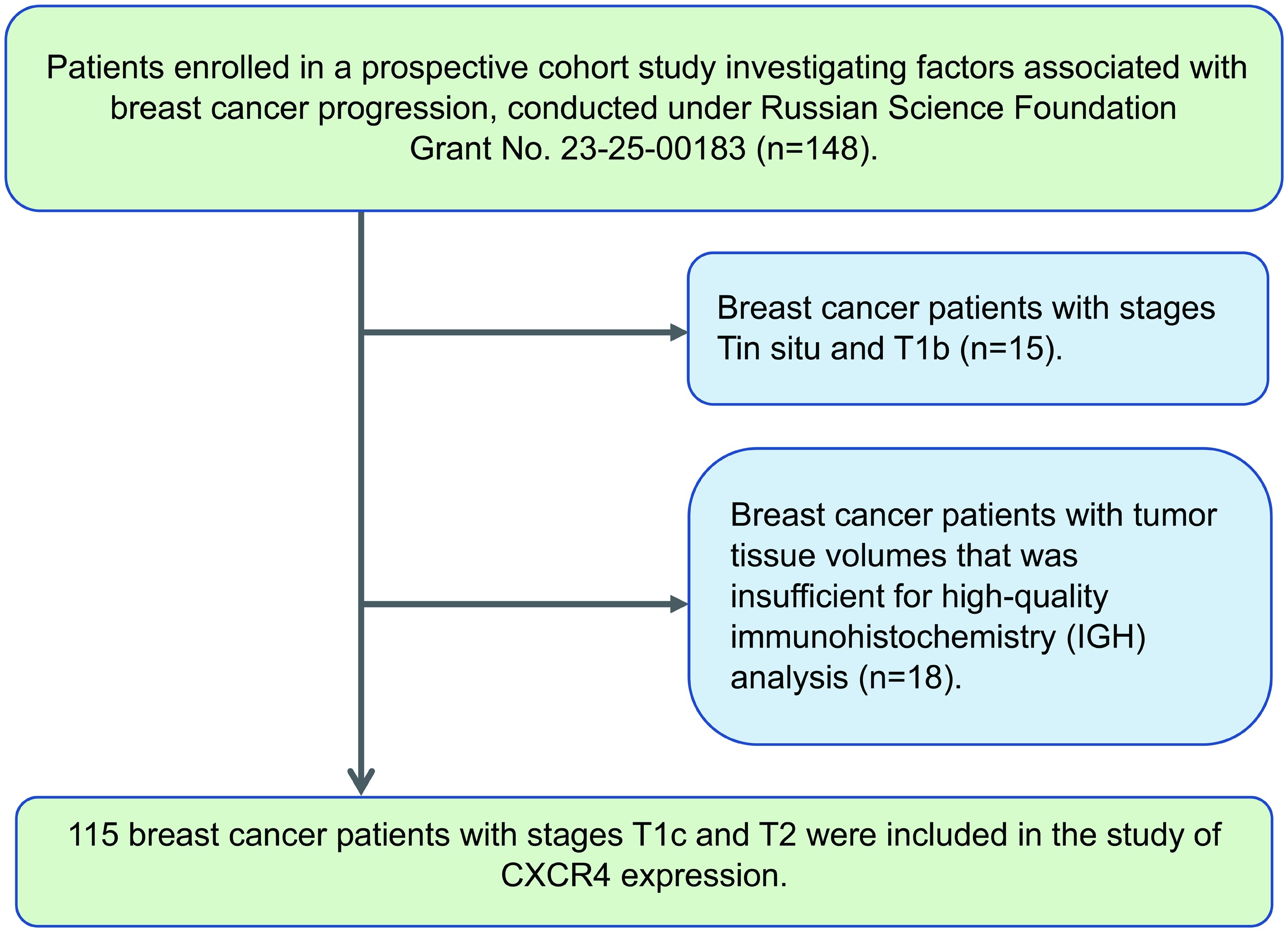
Background and objectives: C-X-C motif chemokine receptor 4 (CXCR4) plays an important role in various physiological and pathological processes. The objective of this study was to evaluate the features of CXCR4 expression in tumor cells (TCs) and immune cells (ICs) and to determine the correlation of these markers with clinical characteristics and prognosis in patients with breast cancer (BC). Methods: This prospective, single-center cohort study included 115 patients aged 37 to 87 years with stage T1 and T2 BC. Tumor sections were stained with antibodies against CXCR4. Statistical analysis was performed using Statistica 12.0 software. Results: Moderate CXCR4 expression in TCs was significantly more frequent in patients with G3 tumors (odds ratio (OR) = 4.17; 95% confidence interval (CI): 1.34–13.02; P = 0.014) and a Ki-67 index ≥ 40% (OR = 47.58; 95% CI: 20.82–803.36; P = 0.0074) and significantly less common in patients with luminal A BC (OR = 0.08; 95% CI: 0.03–0.21; P < 0.0001). Moderate and pronounced CXCR4 expression in ICs was also significantly more frequent in patients with G3 tumors (OR = 2.88; 95% CI: 1.25–6.59; P = 0.0125) and a Ki-67 index ≥ 40% (OR = 6.27; 95% CI: 2.52–15.62; P = 0.0001) and significantly less common in patients with luminal A BC (OR = 0.15; 95% CI: 0.06–0.37; P < 0.0001). No significant differences in 2-year disease-free survival were detected based on the level of CXCR4 expression in TCs and ICs; however, in multivariate regression analysis, moderate CXCR4 expression in TCs was associated with an increased risk of BC recurrence (P = 0.0164). Conclusions: The results of this study demonstrate a link between CXCR4 expression and factors associated with an unfavorable prognosis in patients with BC, including G3 tumors and a high Ki-67 index.

This work is licensed under a Creative Commons Attribution-NonCommercial-NoDerivatives 4.0 International License.
Copyright (c) 2026 Nature Cell and Science