

Keywords
Genomic Topology
Germline-Somatic Interactions
Minimal Residual Disease (MRD)
Synthetic Lethality
How to Cite
Abstract
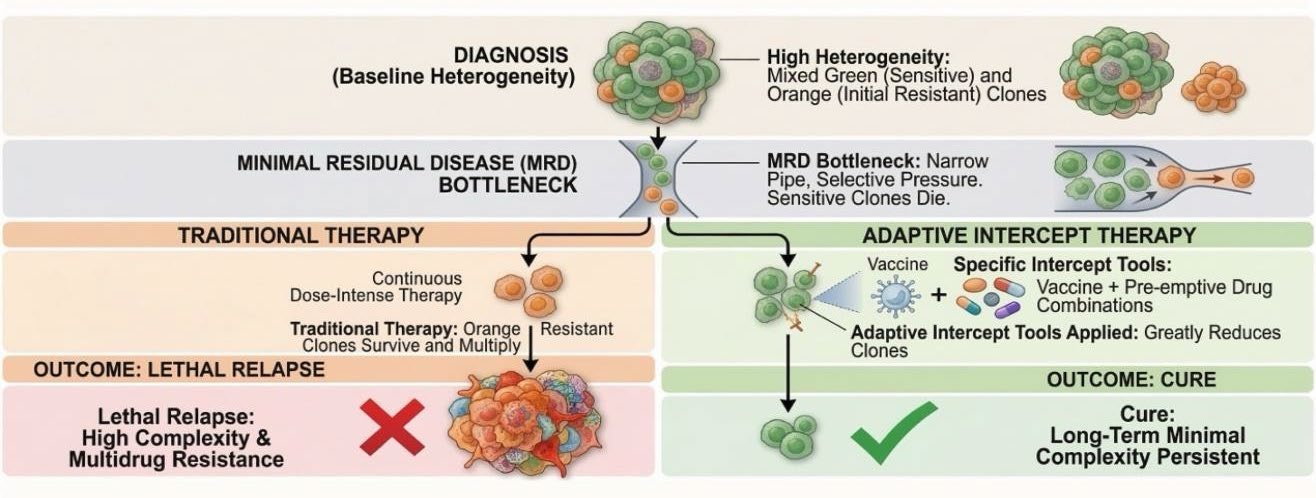
The development of therapeutic resistance in solid tumors is not merely an incidental response, but a relentless recapitulation of Darwinian evolution under profound pharmacological pressure. Consequently, traditional reactive clinical paradigms are increasingly demonstrating insurmountable limitations. This review highlights the critical paradigm shift from late-stage containment towards "evolutionary interception", a proactive approach that predicts and pre-emptively blockades resistance trajectories during therapeutic windows of minimal clonal complexity. We delineate how the germline genetic background imposes hard constraints on somatic adaptation and creates targetable genomic topologies, exemplified by the baseline hemizygous loss of RB1 in BRCA2-mutated breast cancer. Furthermore, we explore the propulsion of drug-independent evolution by endogenous mutational engines, including homologous recombination deficiency and APOBEC3, alongside non-genetic adaptations such as transcriptional rewiring and lineage plasticity. Translating these evolutionary concepts requires high-resolution monitoring through circulating tumor DNA, graph genome algorithms, and single-cell multi-omics. Finally, we critically evaluate frontier clinical strategies, such as upfront synthetic lethality and neoantigen vaccines, while addressing the profound challenges of cumulative toxicity and therapy-induced regressive evolution.

This work is licensed under a Creative Commons Attribution-NonCommercial-NoDerivatives 4.0 International License.
Copyright (c) 2026 Nature Cell and Science